How to Train a American Bully: The Complete Guide
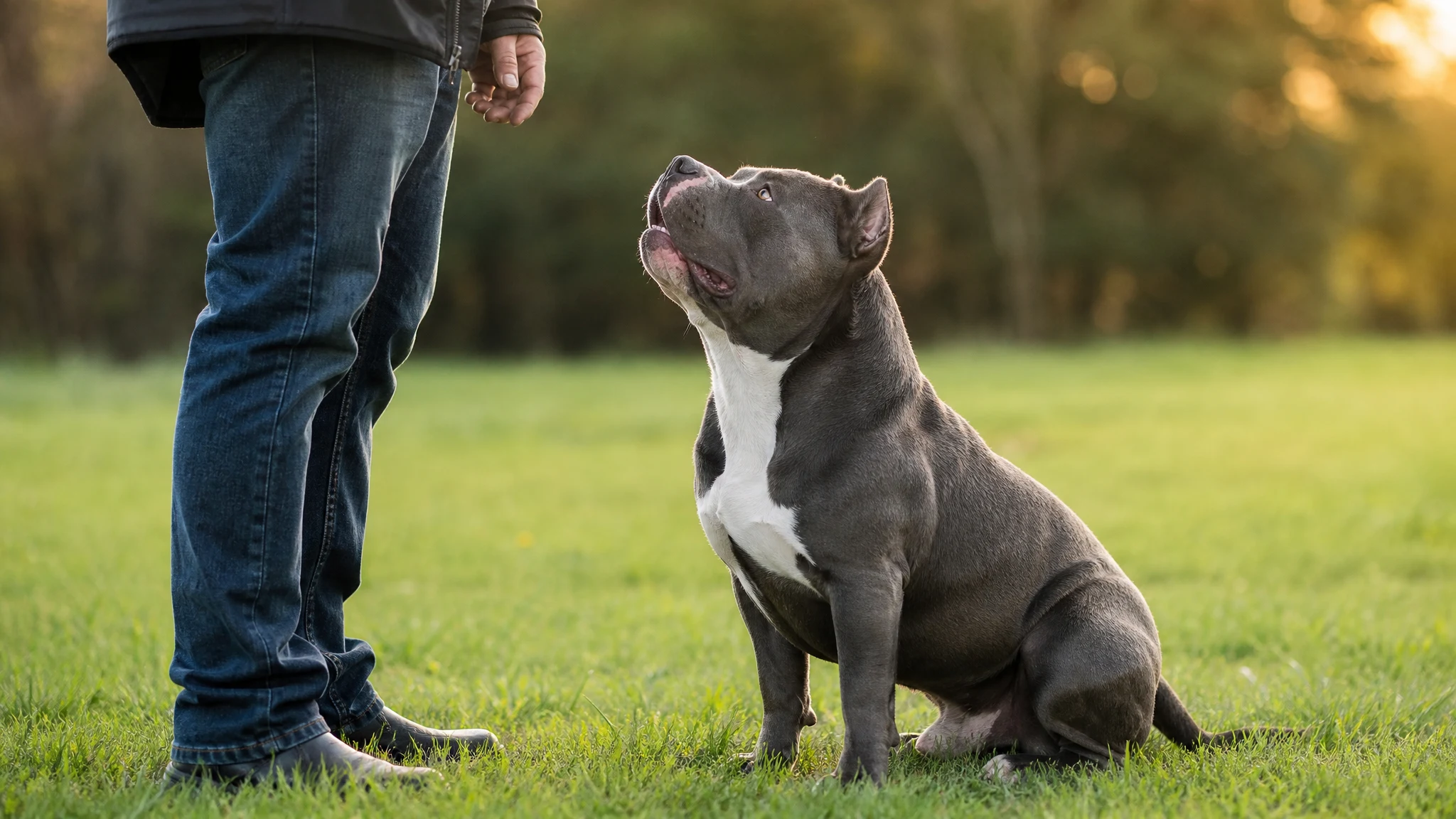
General training information. Every dog is an individual; for health or behavior concerns, see your veterinarian.
The American Bully looks like a bodybuilder and, according to its breed standards, is meant to act like a friendly companion. Training is where those two things meet. This guide covers American Bully training from the first week home through adulthood, using humane, reward-based methods.
You will find what the breed was developed for, how that shapes your plan, the stages of training, what motivates a dog, how to balance exercise with mental work, and the challenges worth planning for. Every dog is an individual, so treat the breed information as a starting point and let your own dog set the pace.
Key Takeaways
- The United Kennel Club (UKC) lists the American Bully as a companion dog developed in the United States as an extension of the American Pit Bull Terrier. Training should aim at a calm, friendly household dog.
- Both the UKC and the American Bully Kennel Club (ABKC) describe a gentle, friendly temperament and say aggression toward people is uncharacteristic.
- Start with leash skills, recall, leave it, drop and settling on a mat. Reward what you like and manage the environment so unwanted habits are never practiced.
- Physical strength matters even in friendly play, so teach manners early, while the dog is small.
- Plan for heat, overfeeding, other-dog introductions and housing rules before they become problems.
- Use only reward-based methods. Take any health or pain question to your veterinarian.
Table of Contents
- What the American Bully Was Developed For
- Set the Foundation Before Formal Training
- Training Stages: Puppy to Adult
- Motivation That Works
- Exercise and Mental Work
- Challenges to Plan For
- Common Questions About American Bully Training
What the American Bully Was Developed For
Training goes better when you know what the dog was built to do. The United Kennel Club (UKC) breed standard says the American Bully was developed in the United States as an extension of the American Pit Bull Terrier. Its original purpose is listed as companion dog, and the UKC places it in the Companion Dog Group. The UKC recognized the breed on July 15, 2013.
The American Bully Kennel Club (ABKC), which standardized the breed in 2004, is the other major registry. The American Bully is not recognized by the American Kennel Club (AKC), so you will not find an AKC breed page or an AKC parent club for it. If you want registration or event details, go to the UKC and ABKC directly.
What the standards say about temperament
The ABKC standard describes the breed as confident, willing to please, gentle and friendly, and says human or dog aggression is uncharacteristic. The UKC standard describes a gentle and friendly demeanor and calls aggression toward humans uncharacteristic and highly undesirable.
That tells you the goal. You are training a companion that is meant to be social, steady and easy to live with. You are not training a guard or a fighter, and you should never encourage that kind of behavior.
A standard describes an ideal, though, and individual dogs vary. Breeding, early experiences and personality all matter. Treat the standard as what a well-bred, well-raised dog should be like, then watch the dog in front of you.
Size varieties and why they matter for training
The UKC recognizes Pocket, Standard/Classic and XL varieties. The ABKC lists Pocket, Standard, Classic and XL. According to the UKC standard, measured at the withers:
- Pocket: males under 17 inches (at least 14) and females under 16 inches (at least 13).
- Standard/Classic: males 17 to 20 inches and females 16 to 19 inches.
- XL: males over 20 up to 23 inches and females over 19 up to 22 inches.
The ABKC gives the same Standard range for its Standard variety: males 17 to 20 inches (43 to 51 cm) and females 16 to 19 inches (40 to 48 cm). The ABKC standard sets no particular weight, so do not expect a club to tell you what your dog should weigh. Your veterinarian is the right person to judge a healthy body condition for your individual dog.
For training, the practical point is simple. A thick, muscular dog of any variety can pull hard, jump up with real force and knock a child or an older relative off balance. The time to teach polite habits is while your puppy is small enough to be easily managed.
Set the Foundation Before Formal Training
Most training problems start with the setup, not the dog. Before you teach a single cue, get the basics in place.
Check housing rules first
Petful's American Bully guide lists uncertain housing permission among the breed's known challenges. Some landlords, apartment complexes, homeowners associations and insurers have rules about bully-type dogs. Those rules vary by place, and this guide cannot tell you what applies to you. Check your lease, your local animal control office and your insurance provider before you bring a dog home, and keep any written approval on file.
Build a safe home base
Give your dog a place that is theirs: a crate, a pen or a bed in a quiet corner. Make it pleasant by feeding meals there and tossing in the occasional treat. The goal is a spot where the dog chooses to rest, not a place used as punishment.
- Use baby gates to limit access while the dog is learning house rules.
- Keep chew items ready so the dog has something legal to do with those strong jaws.
- Pick up shoes, remote controls and anything else you do not want chewed.
Management is a training tool
Petful's training notes for the breed make a point that applies to every dog: reward desired behavior, and set up the environment so unwanted behavior is not practiced. Every time a dog successfully steals a sandwich or jumps on a guest, that behavior gets stronger. A gate, a leash indoors or a closed door prevents the rehearsal while you build the habits you want.
Your toolkit
Keep it simple. You need a flat collar or a well-fitted harness, a standard leash, a sturdy chew, a long line for recall practice and a supply of small, soft treats. Shock, prong and choke collars have no place in this plan. The American Veterinary Society of Animal Behavior (AVSAB) supports reward-based training, and aversive tools risk fear and stress, which can make behavior worse.
Training Stages: Puppy to Adult
Petful's training notes for the American Bully suggest starting with leash skills, recall, leave it, drop and mat settling. Those five skills make a strong core for the whole life of the dog. The stages below show one sensible way to build them. Ages are loose guides, and your veterinarian can advise on timing for vaccinations and safe socialization.
Stage 1: The first weeks home
Keep the world small and the lessons short. Focus on routine and confidence.
- Name and attention: Say the name, reward when the puppy looks at you.
- Potty routine: Take the puppy out after sleeping, eating and play, and reward in the right spot right away.
- Handling: Gently touch paws, ears, mouth and collar area while giving treats. This makes grooming and vet visits easier later.
- Crate or pen comfort: Short, pleasant sessions, with the door opened before the puppy gets upset.
- Mouthing: Redirect to a chew item and reward. Calmly end play when teeth land on skin.
Stage 2: Core cues and social learning
Now start the five foundation skills, in sessions of a few minutes at a time.
- Sit and down: Lure with a treat, then reward the position. These give the dog something to do instead of jumping.
- Mat settling: Reward the dog for lying on a mat, then for staying longer. Eventually the mat means "relax" anywhere you take it.
- Leave it: Hold a treat in a closed fist. When the dog stops pawing and sniffing, reward from your other hand. Build up to items on the floor.
- Drop: Trade a toy for a treat. The dog learns that giving things up pays off, which helps prevent guarding.
- Come when called: Use a happy voice and an excellent reward. Practice indoors, then in a fenced yard, then on a long line outdoors. Never call your dog to you for something unpleasant.
Socialization matters in this window too. Introduce the puppy to new people, surfaces, sounds and calm, vaccinated dogs at a pace the puppy can handle. Keep each experience pleasant and let the puppy retreat if needed. Quality beats quantity.
Stage 3: Leash skills
Leash skills deserve their own focus because of the breed's strength. A dog who pulls at 20 pounds will pull harder at 60.
- Start inside the house or in the yard with no distractions.
- Reward the dog for staying next to you, and stop walking the moment the leash tightens.
- Move forward again when the leash goes slack. The dog learns that a loose leash makes the walk continue.
- Change direction often so the dog has to pay attention to you.
- Raise the difficulty slowly: driveway, quiet street, busier places.
If your dog pulls toward something exciting, increase your distance from it rather than fighting. Reward calm behavior before the dog gets overwhelmed.
Stage 4: Adolescence
Adolescence is when many owners feel their training has vanished. A dog who knew "sit" perfectly at four months may act like they have never heard it at ten months. That is normal and not a sign of failure.
- Go back a step in difficulty and rebuild with strong rewards.
- Keep sessions short and upbeat.
- Do more of the management work: long lines, gates, supervised play.
- Stay consistent. Everyone in the house should use the same cues and rules.
Be careful with physical exercise in this stage. Petful's guide on puppy development notes that puppies need age-appropriate movement, not adult conditioning. Avoid forced running, repeated jumping and heavy workouts for a growing dog, and ask your veterinarian what is safe for your dog's joints.
Stage 5: Adulthood and maintenance
Adult training is mostly about keeping skills sharp in real life. Practice cues in new places, with new people and around distractions. Keep rewarding good behavior, even if the treats become less frequent and the praise, play and access to fun things do more of the work.
Adults can still learn new things. Trick training, scent games and new cues are good for a mature dog's mind. It also gives you more reasons to spend time together.
Motivation That Works
Reward-based training works by making the behavior you want worth the dog's effort. The trick is finding out what your dog values and using it well.
Find your dog's currency
Try several rewards and watch the response: soft treats, bits of the dog's regular food, a favorite toy, a quick game of tug or praise and petting. Not every dog values the same things, and the best reward can change with the situation. A treat may mean little in a loud park, while a game with a toy may mean everything.
Mind the calories
Petful lists overfeeding of bulky-looking adults among the breed's challenges. A muscular build can hide extra weight, and training treats add up. Count treats as part of the day's food, use tiny pieces and ask your veterinarian how much your dog should eat and what a healthy body condition looks like. Part of a meal can also be used as training rewards.
Timing and markers
Reward within a second or two of the behavior you want. Many trainers use a marker word like "yes" or a clicker to tell the dog exactly which moment earned the reward. Say the marker, then deliver the treat. Over time the marker alone carries meaning.
Use the "willing to please" quality, but do not rely on it
The ABKC standard describes the breed as willing to please. Many owners find that a dog who enjoys working with people is easier to teach. Still, a willing dog can only follow a plan that is clear. Keep cues consistent, break skills into small steps and end sessions while the dog is still engaged.
What to do about mistakes
When the dog gets it wrong, do not scold, yank the leash or use physical corrections. Reset, make the task easier and reward the next success. Alpha rolls, scruffing and "dominance" methods are outdated and risk damaging your dog's trust. The AVSAB position is that reward-based training is the safer choice for behavior change.
Exercise and Mental Work
A tired dog is not always a trained dog, but a dog with no outlet will find one. Exercise and mental work both belong in the plan.
How much movement
Petful describes daily movement, sniffing, training and play, adjusted for the dog's age, joints, weather and breathing. It suggests two or more moderate walks, taken at cooler times of day. PetsRadar says around an hour of exercise daily. Treat these as rough guides. Your own dog's age, fitness and health decide the right amount, and your veterinarian can help you set it.
Walks that count
Let the dog sniff. Sniffing is real mental work, and a slow, sniffy walk can be more satisfying than a fast march. Mix in training moments: a sit at the curb, a recall on a long line, a leave it past an interesting smell.
Indoor mental work
On hot days or when the weather is bad, use your brain instead of your legs.
- Food puzzles and snuffle mats: Make meals take longer.
- Find it: Hide treats around a room and let the dog hunt.
- Short training games: Practice cues, tricks or nose targeting for five minutes at a time.
- Chewing: Offer safe chew items under supervision.
Play with manners
Play is good for bonding, but strength matters, even in friendly play. Teach a start and stop signal, and pause the game if it becomes too rough. Tug can be a great reward as long as the dog learns to drop the toy on cue. Supervise play with children and teach children to be calm and respectful.
Petful says the American Bully can live successfully with respectful children when adults supervise. The ABKC-hosted original standard calls the breed excellent with children. Neither takes the place of supervision. Never leave a young child alone with any dog.
Sports and activities
The UKC standard says the ideal American Bully has the athleticism for performance events. UKC performance events, such as weight pull, are open to UKC-registered dogs. The sources do not name American Bullies in a specific event, so contact the UKC or a local club to find out which activities accept your dog and what the rules are. Before any strenuous activity, talk to your veterinarian about whether your dog is fit for it.
Challenges to Plan For
Petful names four challenges for the breed: physical strength even in friendly play, overfeeding of bulky-looking adults, heat tolerance and uncertain housing permission. Here is how to plan for each, plus a few others every owner should expect.
Strength
A friendly greeting from a strong dog can still hurt. Teach "four on the floor" early by rewarding sitting for greetings, and ask visitors to ignore a jumping dog and reward a sitting one. Use a leash or gate when guests arrive until the dog is reliable. Practice calm settling on the mat before you need it.
Weight
Keep food portions measured, keep treats small and check body condition regularly. If you cannot feel the ribs under a layer of muscle, or you are unsure, ask your veterinarian. Do not give supplements to "bulk up" a growing dog. Petful's puppy guidance says steady development is safer than supplementing for bulk, and that puppies expected to become large adults may need a large-size growth diet. Ask your veterinarian which food suits your puppy.
Heat
Petful warns that the compact, muscular build can struggle in heat. Walk early or late, bring water, rest in shade and keep sessions short in warm weather. Never leave a dog in a parked car. If your dog shows heavy, labored breathing or seems unwell, contact a veterinarian right away. Do not try to diagnose or treat it yourself.
Other dogs
Petful says how American Bullies get along with other dogs varies widely, and recommends neutral introductions and close observation. Meet new dogs on neutral ground, such as a quiet street, with both on leash and plenty of space. Keep first meetings short and calm. Watch body language: loose, wiggly movement is a good sign, while stiffness, staring or a freeze is a signal to create distance.
Do not force greetings. A dog does not need to like every other dog, and plenty of happy dogs prefer their own people. Both clubs' standards say dog aggression is uncharacteristic, so a dog who shows persistent aggression toward other dogs or people deserves a professional look. Talk to your veterinarian first to rule out pain or illness, then ask for a qualified trainer or behavior professional who uses reward-based methods.
Skin and health
There is little formal health data for the breed, and Wikipedia notes there is minimal information on health. Petful lists skin signs worth a vet visit: odor, redness, hair loss, greasy skin, recurrent ear debris and persistent licking. Itching and discomfort can look like a behavior problem, so if your dog's behavior changes suddenly, check with your veterinarian before assuming it is a training issue.
The sources on lifespan do not agree. PetsRadar gives 8 to 13 years, while Petful says no single number applies to every American Bully. Ask your veterinarian about what to expect for your dog. I could not find a published health-screening list for the breed, so ask your breeder and veterinarian which tests make sense for the dog's lines.
Coat care
Petful describes a short coat with usually manageable shedding, helped by weekly brushing, which can increase seasonally. Brushing doubles as handling practice, so reward the dog and keep it pleasant.
Housing and public perception
Because of the breed's look and its ties to the American Pit Bull Terrier, some people react with worry before they meet the dog. You cannot change that, but you can control what your dog does. A dog who walks calmly on a loose leash, sits for greetings and ignores distractions is the best advertisement for the breed. Keep your dog under control in public, follow local leash laws and always pick up after your dog.
Common Questions About American Bully Training
When should I start training an American Bully puppy?
Start the day the puppy comes home. Begin with routine, handling, potty training and gentle introductions to new things, then add short cue lessons. Ask your veterinarian when it is safe to attend group classes or meet unfamiliar dogs.
Are American Bullies hard to train?
The sources I could verify do not give a trainability rating. The ABKC standard describes the breed as willing to please, but each dog differs. Clear cues, good rewards and short sessions help any dog. Be honest about your dog's progress and ask for help when you are stuck.
Do I need a professional trainer?
Not always, but a class or private session helps many owners, particularly with leash skills and socialization. Look for someone who uses reward-based methods and is comfortable explaining their approach. Avoid anyone who recommends shock, prong or choke collars, alpha rolls or dominance techniques.
How long should training sessions be?
Short. Five minutes at a time, a few times a day, works better than one long session. Stop while the dog is still having fun.
How do I stop my American Bully from pulling?
Teach loose leash walking in low-distraction places, stop moving when the leash goes tight and reward position beside you. Use a well-fitted harness or flat collar. Manage the environment so the dog does not practice pulling on every walk.
Is my American Bully good with kids and other pets?
Petful says the breed can live successfully with respectful children under adult supervision, and that getting along with other dogs varies widely. Supervise, teach everyone the rules and introduce new animals slowly.
Putting It All Together
Good American Bully training is not complicated, but it does take steady effort. Know what the breed standards describe: a friendly, confident companion. Build the five core skills of leash manners, recall, leave it, drop and settling. Reward what you like, manage what you do not, and match exercise to your dog's age and the weather. Plan ahead for strength, weight, heat, other dogs and housing.
Take health questions to your veterinarian, behavior concerns to a qualified reward-based professional, and registration or event questions to the UKC and ABKC. Then enjoy the dog you are raising.