American Bully Puppy Training Timeline: 8 Weeks to 2 Years
General training information. Every dog is an individual; for health or behavior concerns, see your veterinarian.
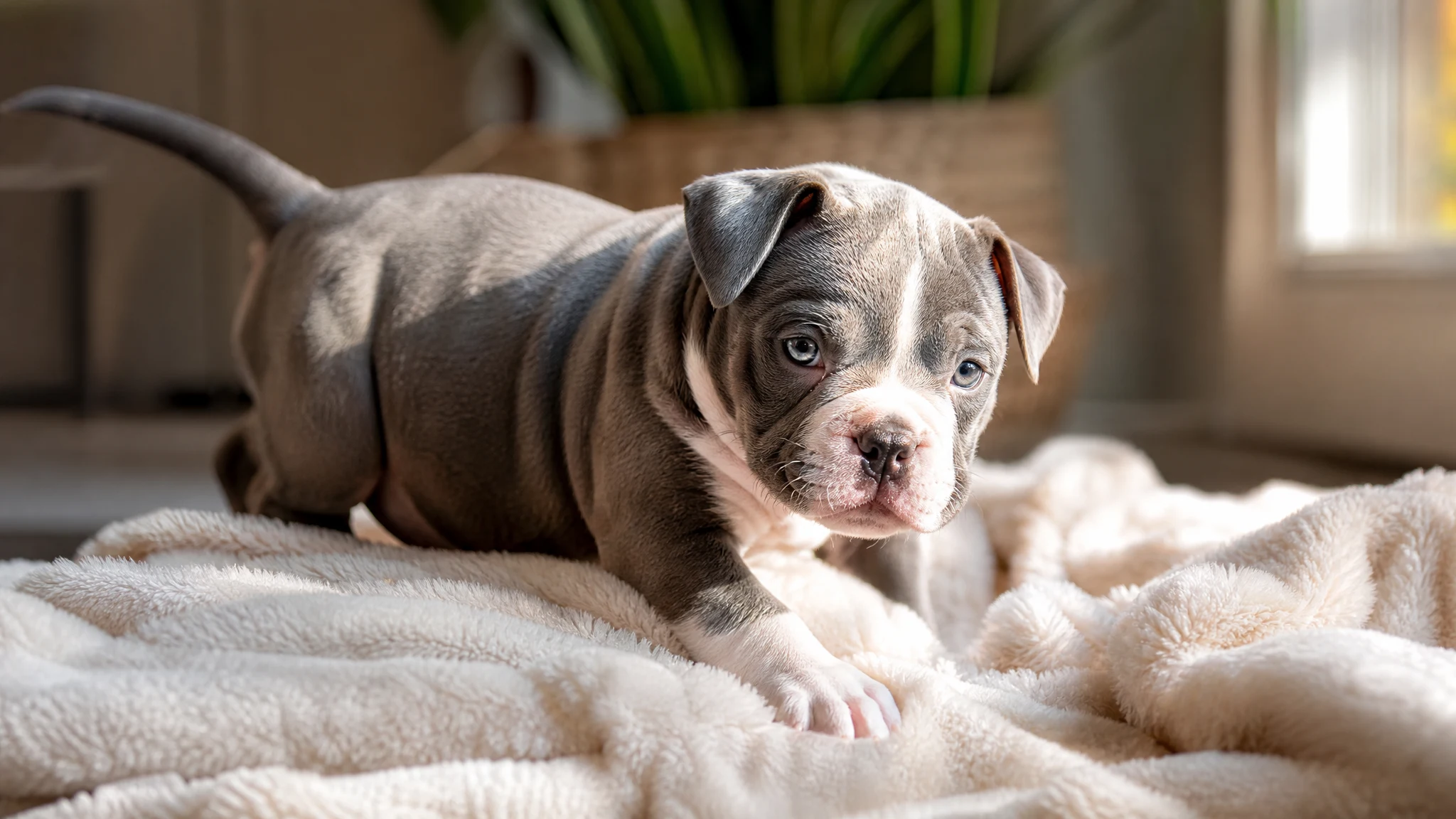
An American Bully puppy looks like a little tank and acts like a clown. That combination is the whole training challenge. The body gets strong long before the brain gets wise, so the work you do in the first two years decides what you live with for the next ten.
This guide walks through American Bully puppy training month by month. It covers the socialization window, house training, bite inhibition, adolescence and maturity. Think of it as a flexible American Bully puppy training schedule, not a rulebook. Every dog moves at its own pace.
Key takeaways
- Start at 8 weeks with short, happy sessions: name, sit, crate, potty routine and gentle handling.
- Use the first months for calm exposure to people, surfaces, sounds and well-chosen dogs. Quality beats quantity.
- Teach bite inhibition and impulse control early. A friendly puppy can still knock you over in play.
- Adolescence is a test of your consistency. Keep rewarding, keep managing, and do not skip steps.
- Growth and joints matter. Puppies need age-appropriate movement, not adult conditioning.
- Every method here is reward-based. Health questions go to your veterinarian.
In this guide
- What to know before you start
- Weeks 8 to 16: the socialization window and first habits
- Months 4 to 6: teething, manners and real-world practice
- Months 6 to 12: adolescence
- Months 12 to 24: maturity
- Exercise, growth and joint care along the way
- Common problems and how to handle them
What to know before you start
The American Bully was developed in the United States as an extension of the American Pit Bull Terrier, and the United Kennel Club (UKC) lists its original purpose as a companion dog. The UKC placed it in the Companion Dog Group and recognized the breed in 2013. The American Bully Kennel Club (ABKC), which standardized the breed in 2004, is the other major registry.
That companion purpose shows in the written standards. The ABKC describes the breed as confident, willing to please, gentle and friendly. The UKC standard calls for a gentle and friendly demeanor and says aggression toward humans is uncharacteristic and highly undesirable. Both clubs describe the temperament you are aiming to grow, not a guarantee. Individual dogs vary, and training is how you shape the one you have.
Size varieties change the picture
The UKC recognizes three varieties, measured at the withers:
- Pocket: males under 17 inches (at least 14) and females under 16 inches (at least 13).
- Standard/Classic: males 17 to 20 inches and females 16 to 19 inches.
- XL: males over 20 to 23 inches and females over 19 to 22 inches.
The ABKC lists Pocket, Standard, Classic and XL, and says its standard sets no particular weight. A bigger dog does not need a different method, but the consequences of a missed lesson get larger as the dog does. Teach the polite version of every behavior while your puppy is still easy to lift.
Your training toolkit
Petful's American Bully guide suggests starting with leash skills, recall, leave it, drop and mat settling. It also advises rewarding the behavior you want and setting up the environment so the puppy cannot practice the behavior you do not want. That is the backbone of everything below.
Keep rewards small and frequent. Use food, toys, praise and access to things the puppy wants. If a session goes badly, make the next task easier and end on a win. Avoid anything that scares or hurts the puppy. Fear teaches a strong dog to avoid, freeze or defend itself, and none of those help you.
Weeks 8 to 16: the socialization window and first habits
This is the most valuable stretch of American Bully puppy training. The puppy is curious, quick to bond and still learning what the world is. Your job is to make that world feel safe and interesting.
Week 8: the first days at home
Keep the first week quiet. Set up a crate or pen, a water bowl and a chew-safe area. Let the puppy learn one room, then another. Pick a name and use it with a treat many times a day so the puppy learns that hearing it is good news.
Start with these basics, all in sessions of one to three minutes:
- Name response: say the name, reward when the puppy looks at you.
- Sit and down, lured with a treat and marked with a word like "yes."
- Crate comfort: toss treats in, feed meals in there, close the door for seconds, then minutes.
- Handling: touch paws, ears, mouth and tail gently, pairing each touch with a treat.
House training
House training is mostly management. Puppies cannot hold it long, so you take them out often and reward in the right spot.
- Take the puppy out after waking, after meals, after play and before bed.
- Go to the same spot and wait calmly. Reward immediately after the puppy finishes.
- Keep the puppy where you can see it, or in the crate or pen when you cannot.
- If an accident happens, clean it with an enzyme cleaner and move on. Never punish after the fact.
Expect setbacks. Many puppies get the idea within weeks but need months of supervision before they are reliable. Do not give free run of the house until the puppy has gone a long stretch without accidents.
Bite inhibition
Puppies explore with their mouths. With a muscular breed, the goal is not to stop all mouthing on day one. It is to teach that teeth on skin ends the fun.
- When teeth touch you, stop playing and calmly stand up or step away for a few seconds.
- Hand the puppy a toy instead and reward when it takes it.
- Reward gentle mouths and calm hands before the puppy gets excited.
- Give plenty of safe chew items so the urge has somewhere to go.
Do not hold the puppy's mouth shut, pin it or yell. Those habits create fear or turn the game into a fight. Calm repetition works better.
Socialization
Socialization means safe, positive exposure. It does not mean letting the puppy meet every dog and person it can. Plan short outings to see and hear everyday things: car rides, hard floors, umbrellas, strollers, delivery people, city noise. Let the puppy watch from a comfortable distance and give treats for staying relaxed.
For other dogs, Petful notes that behavior with other dogs varies widely and recommends neutral introductions and close observation. Choose calm, vaccinated, friendly adult dogs and keep meetings short. Ask your veterinarian which places are safe for your puppy before its vaccine series is complete.
Months 4 to 6: teething, manners and real-world practice
Around this stage the puppy loses baby teeth and chews harder. Mouthing may seem to get worse before it gets better. Rotate chew toys and keep forbidden items out of reach. If gums or teeth worry you, your veterinarian is the right call.
Build the skills that matter in daily life
Now you can stretch sessions slightly and add distance, distractions and duration.
- Leash skills: reward the puppy for staying near you. Start indoors, then the yard, then quiet streets. Stop walking the moment the leash goes tight, and move on when it loosens.
- Recall: call the puppy only when it is likely to succeed and pay well, with the best treat you have. Practice on a long line in safe areas.
- Leave it: hold a treat in a closed hand, reward when the puppy backs off, then progress to treats on the floor.
- Drop: trade a toy for a treat so giving things up feels like a bargain.
- Mat settling: reward the puppy for lying on a mat, then build time. This gives you an off switch for a dog with a lot of drive to play.
Greeting manners
Petful lists physical strength, even in friendly play, as a known challenge for the breed. A puppy that jumps on guests now will be a dog that jumps on guests later. Teach that four paws on the floor or a sit earns attention. Ask visitors to wait until the puppy is calm, and keep a leash on during greetings if needed.
Alone time
Practice short separations from the start. Leave the puppy with a chew for a few minutes, return before it gets upset, and slowly extend. If the puppy panics when alone, talk to your veterinarian or a qualified reward-based trainer rather than pushing through.
Months 6 to 12: adolescence
Adolescence is when many owners feel the training "fell apart." The puppy that sat perfectly now acts as if it never heard the word. This is normal. The brain is changing, confidence is rising, and the world is more exciting than you are.
What changes
- Recall gets worse because everything else is more interesting.
- Energy goes up and patience goes down.
- The puppy may test rules it used to follow.
- Behavior with other dogs can shift as the puppy matures. Keep watching body language.
What to do
Go back to basics without scolding. Shorten the distance, raise the rewards and practice in easier places. Keep the leash or long line on in unfenced areas. Management is not failure. It keeps the puppy from rehearsing the wrong behavior, which is exactly what Petful's training notes advise.
Keep a steady daily rhythm of walks, play, sniffing and short training sessions. A bored adolescent finds its own entertainment, and it is usually your couch.
Dogs, children and guests
Petful says the breed can live successfully with respectful children when adults supervise, and the original standard hosted by the ABKC calls the breed excellent with children. Take both as an argument for supervision, not a reason to relax it. Teach children to leave the dog alone while it eats, chews or rests. Teach the dog that kids are fun and predictable.
For dog-to-dog meetings, keep using neutral ground and close observation. If you see stiff posture, hard staring or repeated rough behavior, increase distance and call a qualified reward-based trainer or your veterinarian.
Months 12 to 24: maturity
By the first birthday the puppy may look like an adult, but looking grown and being grown are different. No club standard or source we are citing gives a single age at which an American Bully is fully mature, so ask your breeder and veterinarian how your own dog is developing. Plan for the mental side to take well into the second year.
Year two priorities
- Proof your skills: practice sit, down, recall and leave it in busier places and around bigger distractions.
- Lengthen the stay: add time, distance and visitors at the door.
- Keep the leash manners: a strong adult pulling on the leash is a safety problem, not just an annoyance.
- Refresh socialization: keep calm, regular exposure to new places, people and dogs. Do not assume it was finished at four months.
Jobs and sports
The UKC standard says the ideal American Bully has the athleticism for performance events, and UKC performance events such as weight pull are open to UKC-registered dogs. The pages we reviewed do not name the American Bully in a specific event, so check with the UKC about eligibility and rules before you plan on competing. For many owners, a good job is simply a structured daily routine: a walk with sniffing, a short training game and a settle on the mat.
Keep the weight honest
Petful warns about overfeeding bulky-looking adults. A heavy dog strains the joints and struggles more in heat. Ask your veterinarian what a healthy body condition looks like for your dog and adjust food and treats together. Count training treats as part of the daily meal.
Exercise, growth and joint care along the way
Training and body care are linked. A tired, comfortable puppy learns better than an overheated or sore one.
Growth and food
Petful says puppies expected to become large adults may need a large-size growth diet, and that steady development is safer than supplementing for bulk. In plain terms, do not push a puppy to look huge. Ask your veterinarian which puppy food fits your dog's expected size, and do not add supplements on your own. Questions about doses belong with your veterinarian.
Age-appropriate movement
Petful also says puppies need age-appropriate movement, not adult conditioning. For a growing American Bully, that means:
- Short, frequent walks and free play on soft, safe ground.
- No forced running next to a bike, long runs or repeated hard jumping while the puppy is growing.
- Short training games that tire the brain without pounding the joints.
- Rest between play bursts, especially in warm weather.
Ask your veterinarian when it is safe to increase intensity for your dog.
Adult exercise needs
For adults, Petful describes daily movement, sniffing, training and play, adjusted for age, joints, weather and breathing, with two or more moderate walks at cooler times of day. PetsRadar says around an hour daily. Treat those as ballparks and let your dog's condition and your veterinarian guide the details.
Heat
Petful warns that the compact, muscular build can struggle in heat. Walk early or late, bring water, choose shade and stop at the first sign of heavy panting or slowing down. Never leave the dog in a parked car. If you think your dog is overheating, contact a veterinarian right away.
Skin and general health
Formal health data on the breed is thin. Wikipedia states there is minimal information on health, and we did not find a club or veterinary school source on required screening tests, so ask your breeder and veterinarian what they recommend. Petful lists skin signs worth a vet visit: odor, redness, hair loss, greasy skin, recurrent ear debris and persistent licking. Short coats usually shed in manageable amounts with weekly brushing, though shedding can increase seasonally, says Petful. Brushing doubles as handling practice and a chance to spot changes early.
On lifespan, PetsRadar gives 8 to 13 years, while Petful says no single number applies to every American Bully. Treat any figure as a rough range.
Common problems and how to handle them
Pulling on the leash
Reward position beside you, stop when the leash tightens, and move forward only when it loosens. Short, frequent sessions in low-distraction places work better than long ones. A well-fitted front-clip harness can help with control, but it does not replace training.
Jumping up
Turn away, wait for four paws on the floor, then reward. Everyone in the household has to do the same thing or the puppy learns that jumping sometimes works.
Rough play
When play gets too wild, pause it. Ask for a sit or send the puppy to the mat, then restart if the puppy is calm. This teaches that calm keeps the fun going. Strength is a known challenge with this breed, and play that seems friendly can still knock down a child or older adult.
Chewing and destruction
Chewing is normal, and the fix is supply and supervision. Offer appropriate chews, keep valuables away and use the crate or pen when you cannot watch. Increase mental work as well as exercise.
Reactivity or tension with other dogs
Increase distance until your dog can look at another dog and stay relaxed, then reward calm behavior. Do not drag a tense dog closer. If your dog shows persistent fear or aggression, consult a veterinarian first to rule out pain or illness, then work with a qualified trainer who uses reward-based methods.
Housing
Petful lists uncertain housing permission as a known challenge. Before you commit, check your lease, homeowner association rules and local ordinances, and ask the landlord or agency directly. Do not assume the breed is welcome everywhere.
A simple weekly rhythm
You do not need a perfect schedule. You need a repeatable one. A day might look like this:
- Morning: potty trip, short walk at a cool hour, a breakfast fed from a puzzle or training session.
- Midday: a nap in the crate or pen, then a five-minute training game.
- Afternoon: sniff walk or supervised play, followed by a mat settle.
- Evening: dinner, a short calm outing, handling and brushing, then a last potty trip.
Adjust for age. A young puppy needs more naps and more potty trips. A teenager needs more outlets. An adult needs a steady routine that keeps both body and brain in shape.
The thread running through every stage is the same: reward what you like, manage what you do not, and keep sessions short and kind. An American Bully that grows up feeling safe and understood tends to be the dog the breed standards describe: confident, willing to please and friendly. Give it the time, because the second year matters as much as the first.