How Much Exercise Does a American Bully Need? Plus Brain Games
General training information. Every dog is an individual; for health or behavior concerns, see your veterinarian.
The American Bully looks like a dog built for hard labor. The truth is a little softer. The United Kennel Club (UKC) lists the breed in its Companion Dog Group and says it was developed in the United States as a companion. That tells you what this dog wants most: time with you, doing something together.
So how much exercise does an American Bully need? There is no single number that fits every dog. This guide gives you a workable daily routine, ways to adjust it for age and weather, and brain games that tire a dog out without more miles. Individual dogs vary a lot, so treat everything here as a starting point.
What the Sources Say About Daily Exercise
No breed club publishes an exact exercise requirement for the American Bully, and the breed is not recognized by the American Kennel Club, so there is no AKC energy rating to quote. Here is what the available guides do say.
- Petful's American Bully guide describes daily movement, sniffing, training and play, adjusted for the dog's age, joints, weather and breathing. It suggests two or more moderate walks at cooler times of day.
- The PetsRadar breed profile puts the figure at around an hour of activity a day.
- The UKC breed standard says the ideal American Bully has the athleticism for performance events. That tells you the build is capable, but it does not set a daily target.
Put those together and a sensible goal for a healthy adult is about an hour of total activity, split into a few sessions. It should mix walking, play and thinking work. If your dog has any health concern, ask your veterinarian what is safe before you set the plan.
Exercise by Life Stage
Puppies
Petful's guide says puppies need age-appropriate movement, not adult conditioning. That means short, easy outings, free play on soft ground and plenty of naps. Skip long runs, forced jogging and repetitive jumping while the body is still growing.
The sources I relied on do not give a minutes-per-day limit for puppies. Ask your veterinarian how much activity fits your puppy's growth stage. Petful also notes that steady development is safer than pushing for bulk, so avoid extra supplements or heavy workouts meant to build a bigger frame.
Adults
Healthy adults can usually handle the routine in the steps below. Size varies a great deal. The UKC recognizes Pocket, Standard/Classic and XL varieties, and the American Bully Kennel Club (ABKC) lists Pocket, Standard, Classic and XL. A Pocket and an XL may not want the same pace or distance, so watch your own dog's breathing and recovery rather than a chart.
Seniors
The sources I used do not give senior-specific exercise numbers. Many owners shorten the walks, add more sniffing time and lean on gentle brain games as a dog ages. Check with your veterinarian about joints and stamina before changing the routine.
Materials You Will Need
- A well-fitted flat collar or harness and a standard leash
- Fresh water, plus a travel bowl for walks
- Small, soft treats cut into pea-sized pieces, or part of the dog's daily meal
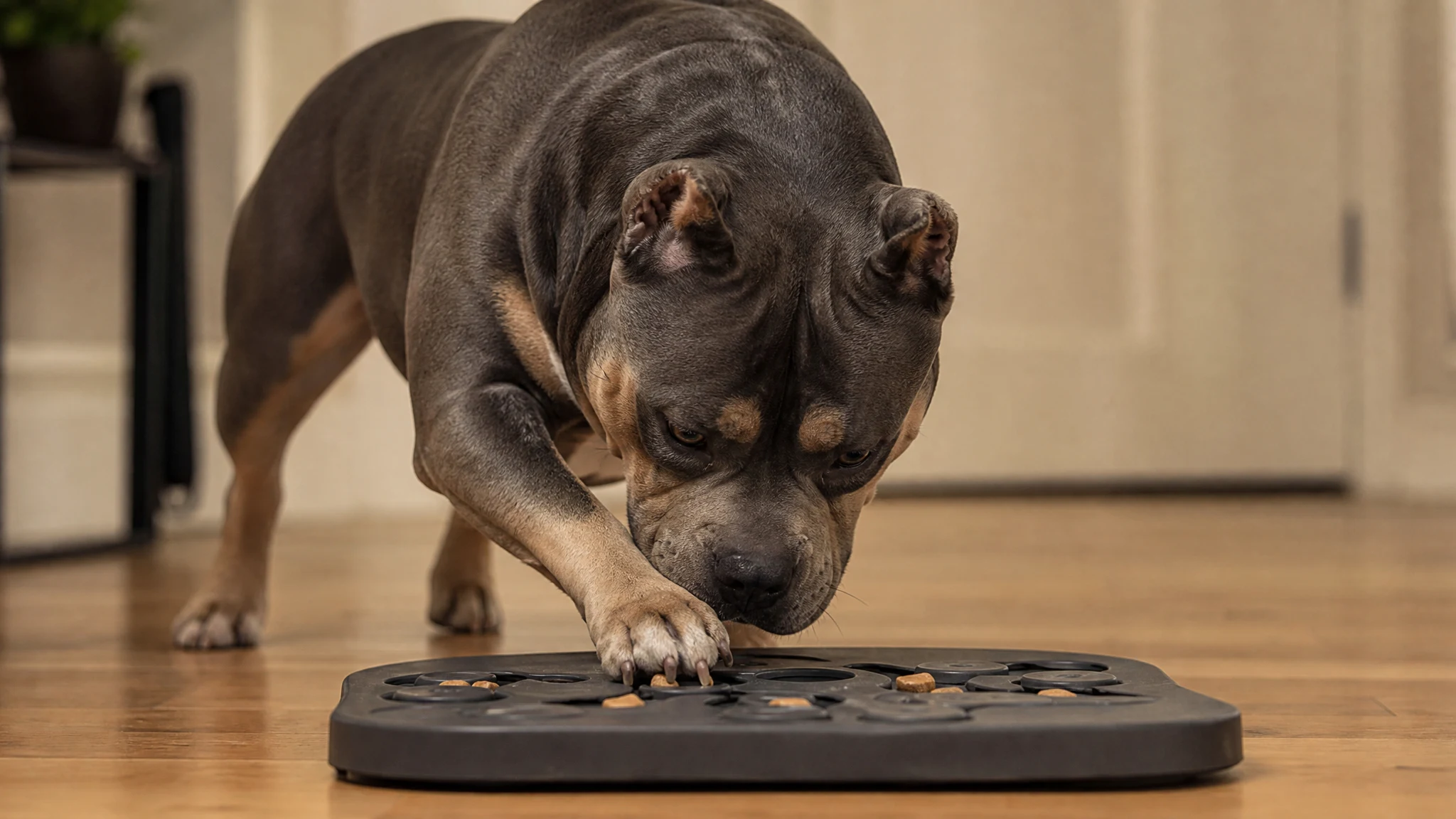
- A puzzle feeder, lick mat or snuffle mat
- A few empty cardboard boxes, towels and paper bags for homemade games
- A mat or bed for settling practice
- A shaded, cool spot for rest after activity
Step-by-Step: Building a Daily Routine
Step 1: Start With Your Dog's Baseline
Before you plan anything, note how your dog is doing now. How long can they walk before panting hard? How quickly do they settle afterward? Do they limp or lag the next morning? Write it down for a week.
If you see limping, labored breathing or reluctance to move, call your veterinarian before adding exercise. Only a vet can tell you what is behind those signs.
Step 2: Plan Two or More Moderate Walks
Follow the pattern Petful describes: two or more moderate walks, timed for cooler parts of the day. Early morning and after sunset are usually best in warm months.
Keep the pace easy at first. Add a few minutes every week only if your dog finishes comfortably and recovers quickly. If you are working on leash skills, a calm walk is also a training session. Our complete guide to training an American Bully covers loose-leash walking in more detail.
Step 3: Respect the Heat
Petful warns that the compact, muscular build can struggle in heat. Treat hot days as indoor days for physical work.
- Move walks to early morning or late evening.
- Stay on shaded or grassy routes. Pavement can get very hot.
- Carry water and offer it often.
- Stop at the first sign of heavy panting, drooling or slowing down, then rest in the shade.
If your dog seems overheated or struggles to breathe, contact a veterinarian right away.
Step 4: Turn One Walk Into a Sniff Walk
Sniffing is part of the daily movement Petful describes, and it is a cheap way to give your dog mental work. Once a day, let your dog lead the pace.
- Pick a quiet route with grass, bushes or a field edge.
- Use a longer, relaxed leash if the area is safe.
- Stop when your dog stops. Let them investigate.
- Move on after a minute or two, using a cheerful voice instead of a leash pop.
Many owners find that a 20-minute sniff walk leaves a dog calmer than a brisk 20 minutes of marching. Results vary from dog to dog.
Step 5: Add Short Play Sessions
Play gives your dog a chance to use that strength and athleticism. Petful names physical strength, even in friendly play, as a known challenge. Plan for it.
- Choose open, non-slip ground.
- Use tug toys with a clear start and finish. Teach "drop" so the game ends when you say so.
- Keep sessions to a few minutes, then give a rest.
- Avoid rough wrestling with guests or children. Supervise all play with kids.
Petful says an American Bully can live successfully with respectful children when adults supervise. Supervision is the key word.
Brain Games for American Bully Mental Stimulation
American Bully mental stimulation matters just as much as the miles. A dog bred as a companion tends to enjoy tasks that involve you. These games need little space and no special gear.
Puzzle Feeders and Lick Mats
Feed part of a meal from a puzzle feeder or smear a lick mat with something safe your veterinarian approves. This turns a two-minute meal into a ten-minute job. It also slows fast eaters.
Scatter Feeding
Toss a handful of kibble into the grass or a towel and let your dog hunt. It is simple, cheap and works indoors on rainy days.
Towel Roll or Box Search
Hide treats in a rolled towel or inside a few open cardboard boxes. Let your dog sort it out. Pick up any cardboard they start to chew.
Find It
- Show your dog a treat, then drop it a step away and say "find it."
- Repeat until they run to the spot happily.
- Hide the treat behind a chair leg or under a cup, in view at first.
- Make it a little harder each round as your dog gets the idea.
Short Training Games
Petful recommends starting with leash skills, recall, leave it, drop and mat settling. Each makes a good brain game when you keep it short and rewarding.
- Mat settling: reward your dog for lying on a mat, then slowly extend the time. This is the "off switch" many owners wish they had.
- Leave it: hold a treat in a closed hand and reward when your dog backs off, then build up to a treat on the floor.
- Recall: practice a happy come-when-called in the house first, then the yard.
- Drop: trade a toy for a treat so letting go is rewarding.
Because the UKC lists the breed as a companion, games that build calm manners, greeting and settling fit what the breed was developed for. Use reward-based methods only, in line with the American Veterinary Society of Animal Behavior (AVSAB).
Sports as an Option
The UKC standard says the ideal American Bully has the athleticism for performance events, and UKC performance events such as weight pull are open to UKC-registered dogs. The sources I relied on do not name American Bullies in a specific event, so check with the UKC or a local club before you sign up. Get your veterinarian's approval first.
A Sample Day
| Time | Activity | Focus |
|---|---|---|
| Early morning | Moderate walk | Loose leash, easy pace |
| Breakfast | Puzzle feeder | Slows eating, uses the brain |
| Midday | Two or three short training games | Leave it, drop, mat settling |
| Late afternoon | Play session | Tug or fetch with a clear end cue |
| Evening | Sniff walk | Dog sets the pace, cool temperatures |
Swap the pieces around to suit your schedule. On a hot day, replace the physical parts with scatter feeding, a box search or a training session indoors.
Tips and Common Mistakes
- Mistake: all exercise, no thinking. A dog can be physically worn out and still restless. Add mental work every day.
- Mistake: exercising in the heat. Petful flags heat tolerance as a challenge for this build. Shift activity to cooler hours.
- Mistake: adult workouts for a puppy. Keep movement age-appropriate and ask your vet about limits.
- Mistake: feeding for bulk. Petful lists overfeeding of bulky-looking adults as a challenge. Extra weight makes every walk harder on the joints. Ask your veterinarian what a healthy weight looks like for your dog.
- Mistake: skipping the cool-down. End play with a few calm minutes on the mat.
- Tip: keep treats small and count them as part of the day's food.
- Tip: watch other dogs carefully. Petful says tolerance for other dogs varies widely and recommends neutral introductions with close observation. Both the UKC and ABKC standards describe aggression toward people as uncharacteristic, but any dog is an individual.
- Tip: if exercise is not enough, do not punish the result. Add structure, rewards and rest.
What Results to Expect
With a steady routine, many owners notice their dog settling more easily at home within a few weeks. Chewing and pacing may lessen, and walks may feel smoother. Results depend on age, health, temperament and how consistent you are, so none of this is certain.
Skin trouble, limping, or heavy breathing that does not ease with rest are reasons to see a veterinarian. Petful lists skin signs worth a vet visit, including odor, redness, hair loss, greasy skin, recurrent ear debris and persistent licking. Do not try to diagnose or treat these at home.
Finally, remember that the UKC and ABKC describe an affectionate, confident companion. Give that dog a daily job, a cool place to rest and your attention, and you are on the right track. For the next step in training, read our complete American Bully training guide.