Socializing a American Bully With Kids, Dogs and Strangers
General training information. Every dog is an individual; for health or behavior concerns, see your veterinarian.
Most people who bring home an American Bully hope for the same thing: a calm, friendly family dog who handles visitors, kids and the neighbor's dog without drama. Good American Bully socialization is how you build toward that. It does not happen by accident, and it does not happen by throwing your dog into a crowd.
This guide walks through a plan you can follow at home. It covers strangers, children and other dogs, in that order of difficulty. Individual dogs vary, so treat the steps as a framework and adjust to the dog in front of you.
What the breed sources say about temperament
The American Bully Kennel Club (ABKC) breed standard describes the breed as confident, willing to please, gentle and friendly. It says human or dog aggression is uncharacteristic. The United Kennel Club (UKC) breed standard also describes a gentle and friendly demeanor, and calls aggression toward humans uncharacteristic and highly undesirable.
That is the goal the breed was built toward. It is not a promise about your dog. Breeding, early experiences and daily handling all shape how a real dog turns out, which is why a plan matters.
Are American Bullys good with kids?
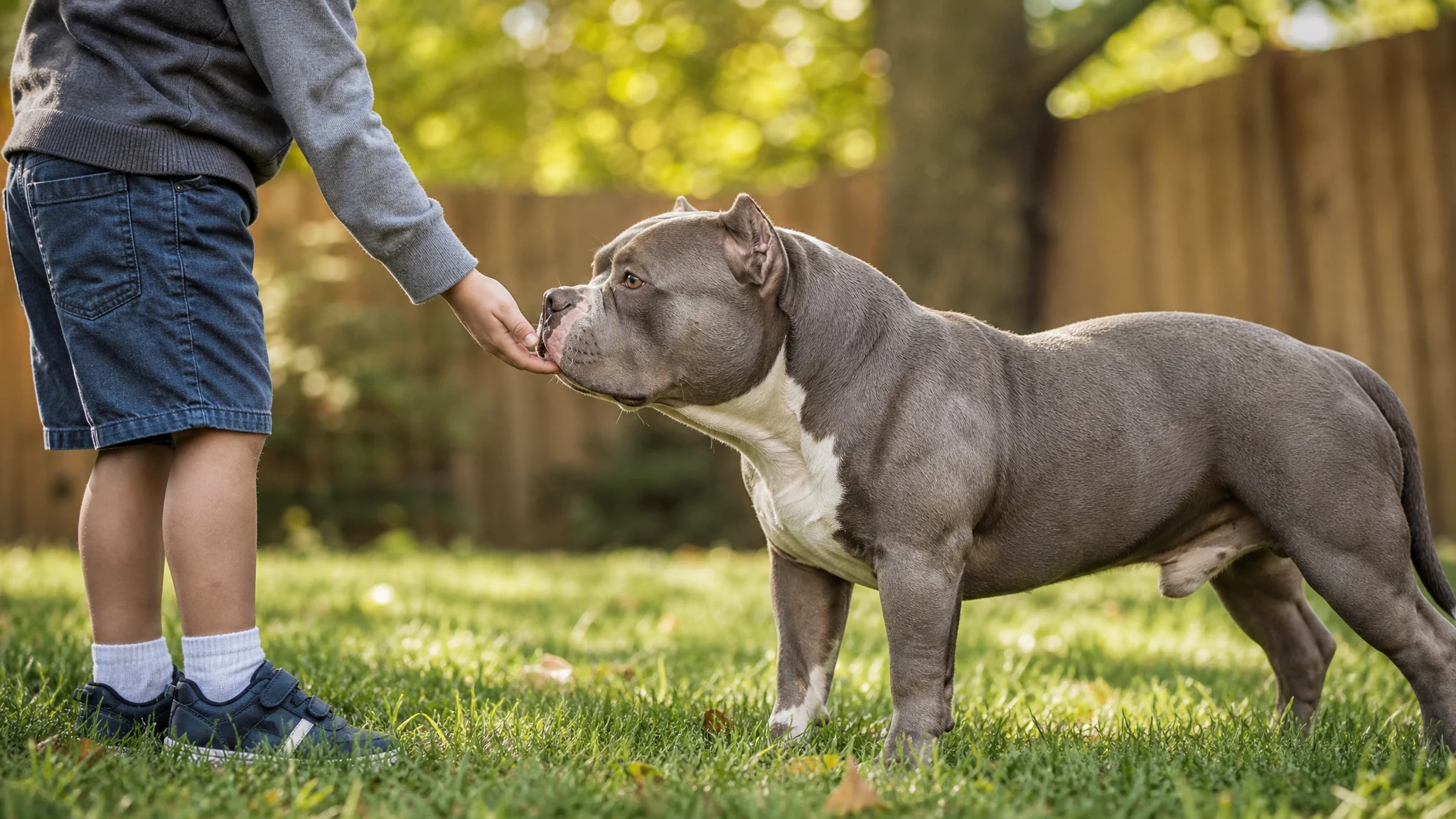
It is one of the most common questions, so here is the honest answer. The original standard hosted by the breed's registries calls the American Bully excellent with children. Petful's American Bully guide, a secondary source, says the breed can live successfully with respectful children when adults supervise.
Notice the condition in that second source. The dog is only part of the equation. The kids need to be respectful, and an adult needs to be watching. Neither source says to leave a dog and a young child alone together, and neither should you.
One challenge worth planning around is strength. Petful lists physical strength, even in friendly play, as a known challenge. A happy Bully who bounces, leans or body-slams can knock over a toddler without any bad intent. Training and management cover that gap.
Materials you will need
- Small, soft treats your dog loves, cut to pea size so you can reward quickly.
- A treat pouch or pocket, so rewards are always within reach.
- A standard 6-foot leash and a well-fitted flat collar or harness. Skip prong, choke and shock tools. Humane, reward-based methods are the approach recommended by the American Veterinary Society of Animal Behavior (AVSAB).
- A mat or bed for settling practice.
- A baby gate or exercise pen to give your dog a break from visitors and children.
- A chew or food puzzle for calm time away from the action.
- Helpers: a few calm adults, a dog-savvy friend with a steady, friendly dog, and children old enough to follow simple rules.
- Water and shade for outings. Petful notes the compact, muscular build can struggle in heat, so plan sessions for cooler times of day.
Step-by-step socialization plan
Step 1: Build the basic skills first
Social outings go better when your dog already knows a few cues. Petful suggests starting with leash skills, recall, leave it, drop and mat settling. These are your steering wheel and brakes in every situation below.
Practice them at home with no distractions first. Our complete American Bully training guide covers these foundations in more detail.
Step 2: Teach the mat as a calm spot
Reward your dog for lying on the mat. Add a few seconds at a time, then add small distractions such as a door opening or a person walking past. The mat becomes the place your dog goes when guests arrive, which beats jumping at the door.
Step 3: Start with strangers at a distance
Go somewhere with foot traffic but plenty of space, like the edge of a park or a quiet sidewalk. Stand far enough back that your dog notices people but can still take treats and respond to you.
When your dog looks at a person and stays relaxed, mark the moment with a cheerful word and give a treat. You are teaching that people appearing means good things happen, not that people mean greeting time.
Over several sessions, shrink the distance a little at a time. Your dog does not need to meet every person. Learning to ignore strangers politely is a useful skill for a strong dog.
Step 4: Practice polite greetings
Ask a calm helper to approach. Cue your dog to sit before the person gets close. If all four paws stay planted, the person offers a brief, gentle greeting. If your dog jumps or lunges, the person calmly steps back and tries again once your dog resets.
Ask helpers to skip leaning over your dog's head, hugging or high-pitched squealing. Those can overexcite a friendly dog or worry a nervous one.
Step 5: Introduce children with rules for the kids
Before the dog is involved, teach the children the rules:
- Stay calm and use quiet voices.
- Pet the shoulder or chest, not the face, ears or tail.
- No hugging, climbing on or lying on the dog.
- Never bother the dog while it eats, chews or rests on its bed.
- If the dog walks away, let it go.
Then keep the first sessions short. Hold the leash, ask your dog to sit or settle on the mat, and let the child offer a treat from a flat hand or toss it. Reward your dog for staying calm. End the session while everyone is still doing well.
Step 6: Supervise play actively
Supervision means an adult within arm's reach who is watching, not scrolling on a phone in the next room. Because of the breed's strength in friendly play, keep games gentle and structured. Fetch with a drop cue works better than wrestling or rough chasing.
Teach your dog to take treats gently and to drop toys on cue. Give the dog a gated break area where children are not allowed to follow. If your dog goes there, that is a request for space, and everyone respects it.
The sources you will find do not flag guarding or herding behavior around children as a breed issue for the American Bully. Still, watch your own dog. Stiffening over a toy or food, blocking a child's path or nipping at running kids are all signs to stop and ask a qualified trainer or veterinary behaviorist for help.
Step 7: Introduce other dogs on neutral ground
Petful says how American Bullys get along with other dogs varies widely, and recommends neutral introductions with close observation. That is solid advice to follow.
- Choose a neutral spot, such as a quiet walk route or a fenced area neither dog calls home.
- Start parallel, walking the same direction with space between the dogs. Let them notice each other without face-to-face contact.
- Close the gap slowly if both dogs look loose and wiggly, with soft bodies and relaxed mouths.
- Keep greetings short, a few seconds, then call your dog away and reward.
- Watch for tension: stiff posture, hard staring, raised hackles or freezing. Calmly increase distance and end the session.
- Only then consider off-leash play, in a secure area, with one familiar dog at a time.
Avoid dog parks as a starting point. They put your dog among many unknown dogs, with little control over what happens. Ask your veterinarian when your puppy is safe to meet other dogs, since that depends on vaccination status.
Step 8: Add variety slowly
Once the basics hold, vary the setting: new streets, a patio at a quiet hour, different kinds of people such as someone wearing a hat or carrying a bag. Change one thing at a time. Each success makes the next one easier.
Tips that make it easier
- Keep sessions short. Five to ten minutes of good behavior beats an hour of struggling.
- Reward what you want. Catch your dog being calm and pay for it. Do not wait for a problem and then punish it.
- Set up the environment. Petful's advice to prevent practice of unwanted behavior fits here. Use gates, leashes and distance so your dog cannot rehearse jumping or lunging.
- Exercise first. A dog who has had a walk and some sniffing is better able to focus. Petful suggests two or more moderate walks at cooler times of day.
- Know your dog's signals. Yawning, lip licking, turning away and a tucked tail all say "too much."
- Watch the weight. A heavy dog tires faster and has a harder time in the heat. Check portions with your veterinarian rather than guessing.
Common mistakes to avoid
- Flooding. Dropping a young dog into a crowd to "get used to it" can create fear instead of confidence.
- Forcing greetings. Not every dog or person needs to interact. A pass-by with a treat is a fine outcome.
- Trusting the breed's reputation to do the work. Friendly breed standards describe an ideal, not a given.
- Leaving kids and dogs alone together. Even a gentle dog and a well-meaning child can get into trouble in seconds.
- Using harsh corrections. Prong, choke and shock tools, alpha rolls, scruffing and dominance tactics are not part of humane training. They can make a dog more wary of the very things you want it to like.
- Letting the dog be jumpy and calling it friendly. A strong dog that jumps on people is a problem even when it means well.
- Skipping breaks. A tired or overexcited dog makes poor choices. Give it time away.
What results to expect
With consistent practice, many American Bullys become calmer and more reliable around visitors, children and other dogs. Progress is usually gradual, with good days and setbacks. Some dogs may take longer with other dogs, since that area varies widely from one dog to the next.
If you notice growling, snapping or persistent fear, stop the exercises that trigger it and talk with your veterinarian. They can rule out health causes and refer you to a qualified behavior professional. Pain and illness can change a dog's behavior, and this guide cannot diagnose your dog.
Check with your landlord, local housing rules and your city or county about any breed-related requirements. The sources used here do not cover local laws, and Petful lists uncertain housing permission as a known challenge for this breed.